The frequency and complexity of math and physics in the field of rocketry and space exploration is intense, but the fundamentals aren’t so bad. In fact, much of the field is predicated on “the rocket equation,” which is understandable to anyone with an American high school-level knowledge of mathematics.
The Original Equation
The original version of the rocket equation is named for Russian scientist Konstantin Tsiolkovsky, who published his work in the early 1900s. However, several others independently discovered such these relations between variables. Other than William Moore in 1810, the famed physicists and rocket engineers Robert Goddard and Hermann Oberth also developed such models.
The common formulation can be shown as follows:Or in terms of differently written variables:
Where is the ideal velocity gain (typically referred to as Delta-v () or the change in velocity in modern parlance), is the exhaust velocity for the ejected mass, and or represents the mass of the rocket before the fuel is expended and or represent the mass of the rocket after the fuel is expended.
Based on the equations, the logic for several rocket design decisions becomes evident. For example, if you’ve heard of more efficient engines (like electric engines or conceptual nuclear engines) having higher exhaust velocities, that’s represented by the linear correlation with Delta-v in the equation. Delta-v, or the total change in speed that you can accomplish, decides where you can go in space by dictating how much you can change your orbit. However, this equation is for a maximally ideal environment: it does not consider losses due to external forces like gravity or drag. It also fails to represent multistage rockets, complex combinations of burns or maneuvers, gravity assists, etc.
Mathematically speaking, is a function that is increasing, concave down, and is at greater than 0 on the interval . Therefore, a greater delta-v is achieved if a greater fraction of the initial mass of the ship is fuel that is depleted compare to “dry mass,” but it is the case that there are diminishing returns. The relationship in the natural log function is where the expression “the tyranny of the rocket equation” comes from: increasing the fuel onboard becomes increasingly pointless as the extra energy required to carry the fuel you’re bringing increases, especially as the structure of the rocket has to become heavier to accommodate the bigger load. Decreasing the denominator of the fraction in the natural log, or in other words, decreasing the weight of the structure of the rocket, is crucial, which is why rockets use thin bodies and advanced, light materials. It’s also why rockets have stages that separate on ascent and throughout the mission: it allows dry mass of the rocket to shrink in steps, increasing .
The Mass Ratio and Mass Fraction
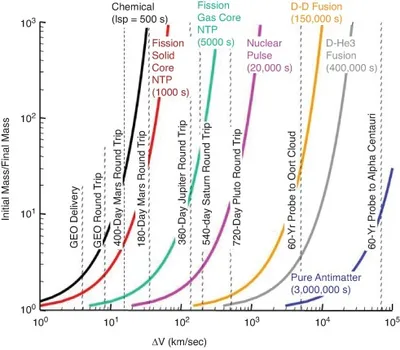
Now, is the mass ratio, representing how many times heavier the rocket is fueled compared to when it is empty. This relationship explains the chart on the left: for a given , engine types with faster exhaust velocities (directly related to specific impulse, a measure of efficiency in seconds) must have lower mass ratios, and vice versa.
You may also see the term mass fraction, which is the fraction of the total mass of the vehicle that is propellant. This can be simply expressed as the propellant mass over the total mass (in this case, but you may see different notations elsewhere).
The relationship with the mass ratio is shown as follows. Dry mass is shown as :