Planets of our Solar System Did you know that Earth is not the only planet? There are seven other planets that go around our Sun. Let’s look at each one! The first one is the closest to the Sun.
Mercury
Image Credit: NASA Media Library PIA11245
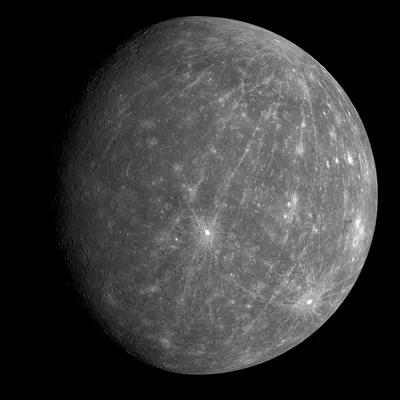
Mercury is the closest planet to the Sun. It can get very hot. It’s the smallest and it goes around the sun the fastest. Also, its days are way longer than Earth’s days. But it doesn’t have air like Earth has air. This means that the dark side gets super cold. It also doesn’t have seasons.
Up close, Mercury looks grayish-brown. Like our moon, the ground is rough from objects in space hitting it. Mercury is too small and close to the Sun to have its own moon.
Venus
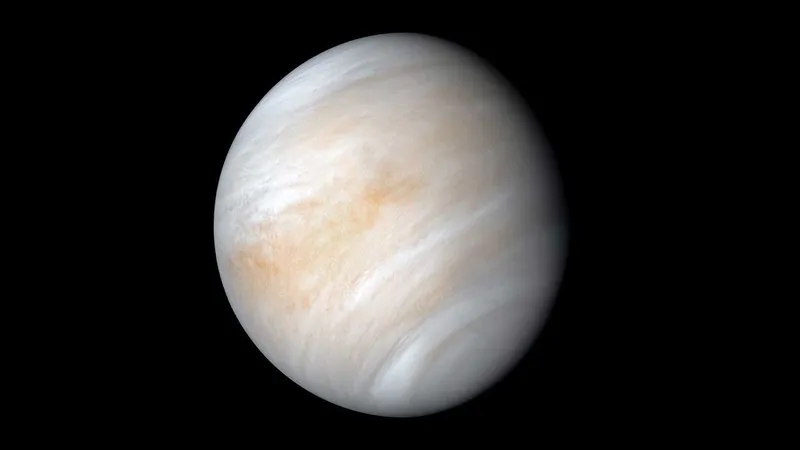
The next planet is Venus, which is also very hot. Venus spins in the opposite direction to the other planets.
Venus is bigger than Mercury. It’s closer to the size of Earth. It even has volcanoes and mountains like Earth. A long time ago, we sent machines to Venus. Those machines got photos of the surface. The air there is very thick and yellow. We could not breathe it if we were there. Like Mercury, Venus does not have a moon.
Image Credit: NASA Media Library PIA23791
Earth
Image Credit: WikiImages via Pixabay
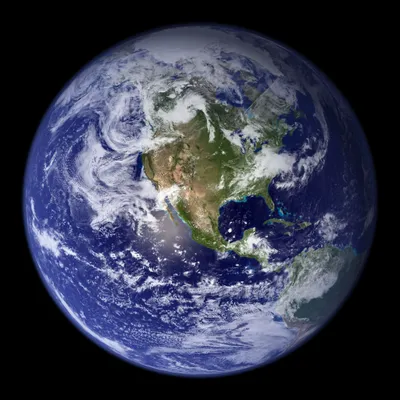
Earth is our planet. Every person who has ever lived has lived on Earth. Way more people have lived here in the past than do now. Before people went to space in the 1960s, no one had ever left our planet. It is the only planet we know that has life, and the only planet we can live on. Temperatures feel good for us and the the sky has the air we breathe. It is important to protect Earth. We don’t know another planet like it. One of the most important things in the night sky is our moon, sometimes called Luna.
Mars
Image Credit: Nasa Media Library PIA07893
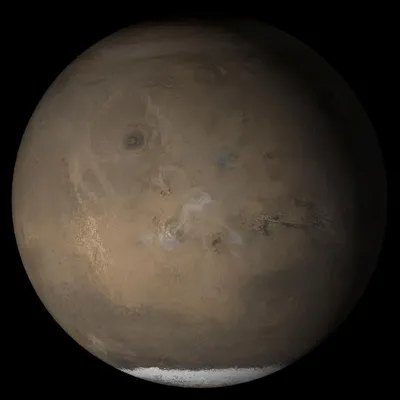
Mars is probably the most well known planet besides Earth. It is called the “Red Planet.” It is called this because of its the color of its surface. Mars is farther from the Sun than Earth. That makes it darker there. Still, it is much closer than the planets after this. Mars has big dust storms and the largest volcano we know about, Olympus Mons. It also has big canyons, like Valles Marineris. These canyons are sometimes way deeper and wider than what we have on Earth. People think that Mars had liquid water and was much warmer a long, long time ago.
Mars has moons Phobos and Deimos.
Jupiter
Image Credit: Nasa Media Library PIA00343
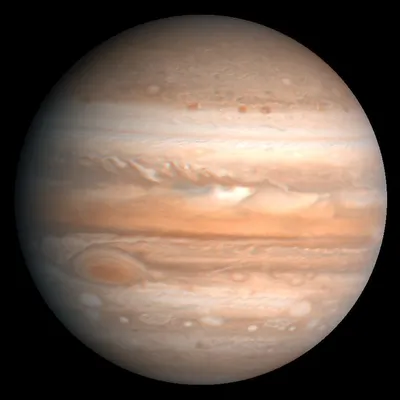
Jupiter is the biggest of the planets that go around the Sun. The planet is mostly gas. Because of that, it is called a “gas giant.” It has stripes of many colors. Some stripes are brown or white, and others look more blue. Storms can lie in these clouds, and a popular example is the Great Red Spot. Unlike Earth’s storms, the storms on Jupiter can last for years. Also, while the closer planets have no moons or maybe one or two , Jupiter has at least 101 moons. The biggest one, Ganymede, is larger than Mercury. It also has rings that we can’t see.
Saturn
Image Credit: NASA, ESA and E. Karkoschka (University of Arizona)
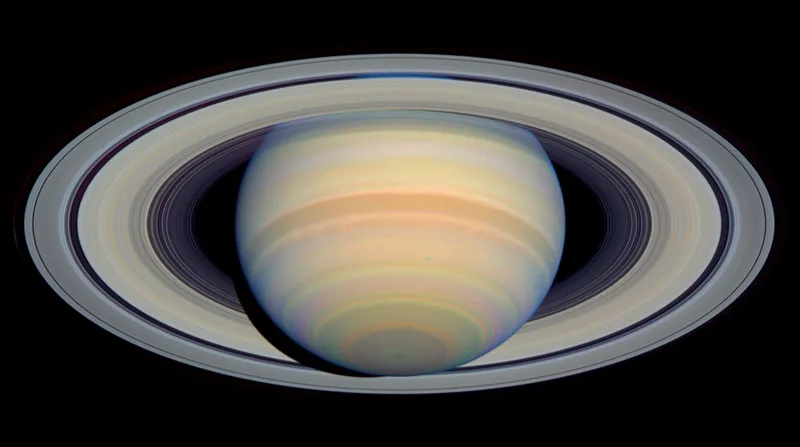
Saturn is the second biggest planet after Jupiter. It’s like Jupiter because it is a gas giant. Like Jupiter, it has varying colors and its owwn weather. It has nearly 300 moons. Saturn is also known for its big rings. These rings look different to us over time. Though it is bright in the night sky, you need to use a tool like a telescope to be able to see the rings.
Uranus
Image Credit: NASA/JPL-Caltech
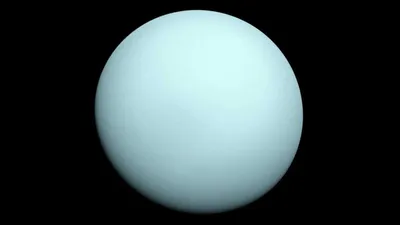
Uranus (said like “your-uhh-nuss”) is very far from the sun. That means that you can’t see it with just your eyes in the night sky. You can see all the earlier planets yourself. Still, Uranus is an interesting planet. Most planets spin around an a line (called an axis) that is close to “up.” But Uranus’s line of rotation is sideways. It’s like something moving along as it rolls like a ball, instead of like a spinning top. This rotation gives the planet strong seasons. Like Jupiter, the rings are not bright. The rings are not good for seeing in a telescope.
Neptune
Image Credit: WikiImages via Pixabay
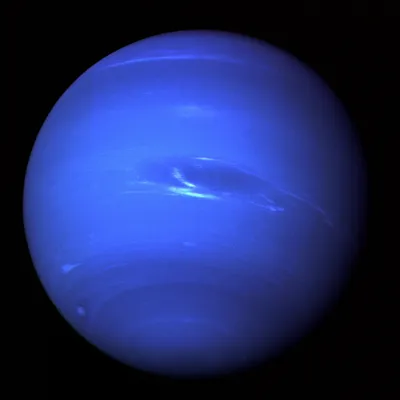
You might have seen the photo of Neptune as very blue. Really, it’s more white with a bit of blue, like Uranus.
It is a bit bluer than Uranus, though.
Many people think that Uranus and Neptune are super cold. After all, they are called the “ice giants.” But actually, Neptune is much hotter than Uranus. It gives out a lot of heat. This creates really fast winds on the planet.
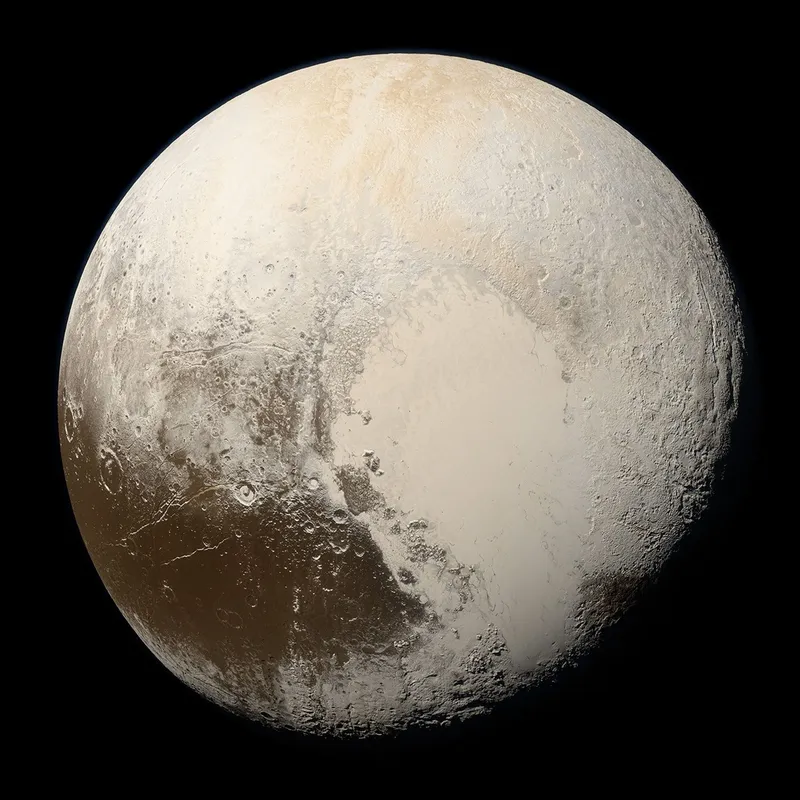
Bonus: Pluto
Image Credit: NASA/Johns Hopkins University Applied Physics Laboratory/Southwest Research Institute/Alex Parker
Is Pluto a planet? Is it not? Most scientists agree that it probably isn’t. Instead, it is a dwarf planet. There are three major rules for deciding what a planet is. Pluto doesn’t follow all of the rules. There are other things in the path of its movement. If it was a planet, we’d have to add planets like Ceres (say it like “sair-eez”) and Makemake (say it like “mahh-kay mahh-kay”). That would be a hassle!
Review
There are a lot of planets. There are even planets outside of our solar system. Some are hot, some are cold, some are rocky, and some are full of gas. Some orbit (or move around) the sun alone. Others have a few moons. Some have hundreds of moons as companions. Space is exciting and huge!